The Salt Behind the Claim: Auditing Softener Brine Across a UK Facility Estate
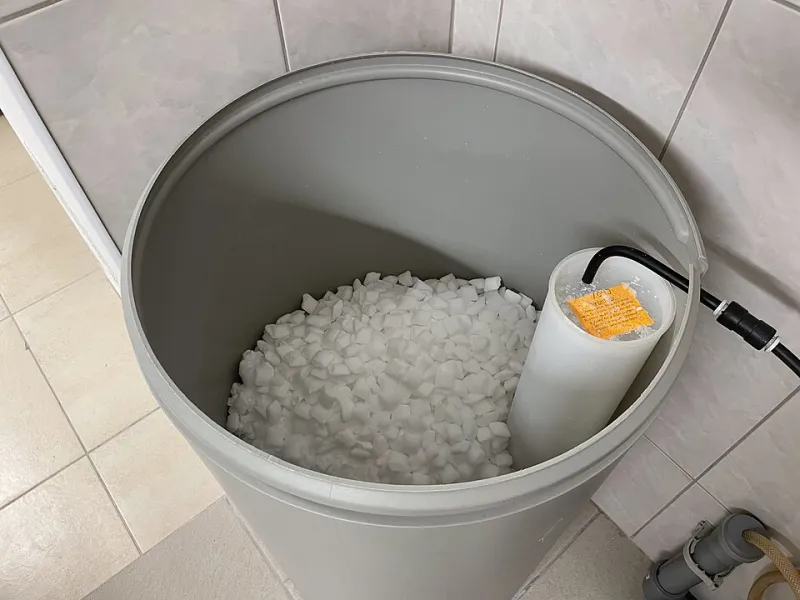
Photo: Muselsom, CC BY-SA 4.0, via Wikimedia Commons
Ask a facilities manager where the water goes and the answer arrives quickly: cooling towers, washdown, domestic services, irrigation. Ask where the salt goes and the conversation usually stalls. Yet every regeneration of a base-exchange softener discharges a concentrated brine slug to drain, and on a large site those slugs add up to tonnes of sodium chloride a year. In catchments where chloride is already a pressure point, that is not a trivial detail.
An Assumption That Has Never Been Tested
Most softener installations were specified for one reason: to protect heat exchangers, boilers and calorifiers from scale. The discharge route was settled at the same time, almost always to foul sewer, on the working assumption that a regeneration is a small, intermittent and essentially domestic-scale event. For a single dwelling that holds. For a hospital, a hotel or a manufacturing site with several hundred litres of resin, the arithmetic changes considerably.
Sewerage undertakers treat softener regenerant and backwash as trade effluent in most cases, which means a consent, conditions and often a charge. Where a consent exists but has not been reviewed since the plant was installed, the chloride figure may never have been modelled at all. Where no consent exists, the discharge may be running outside the terms of the Water Industry Act 1991 without anyone having made a conscious decision about it.
Reading the Consent Properly
Trade-effluent consents commonly regulate volume, pH, suspended solids, COD, fats and, at some sites, specific ions. Chloride is not universal, but it appears often enough in inland catchments, in areas of saline intrusion, and wherever the receiving works discharges to a watercourse with a tight environmental permit. Sulphate and sodium may also be listed where the works has biological or agricultural constraints.
Three questions are worth putting to the undertaker in writing:
- Is the softener discharge included within the existing consent, and if so under what volume and quality limits?
- Does the receiving treatment works have headroom for additional chloride, now and at the next periodic review?
- Would a reduction in chloride load attract a lower volume-based charge or support a variation?
Ask before commissioning a survey, not after. The answer shapes the whole remediation case.
Putting Numbers on the Salt
A softener's salt use is best estimated from two sources that rarely meet: the purchasing record and the regeneration settings. Salt deliveries give the annual mass; the controller gives the frequency and the dose per regeneration. Sulphuric or hydrochloric acid regeneration, where used, needs separate handling entirely.
A worked illustration makes the point. A vessel holding 200 litres of resin, regenerated three times a week at roughly 4 kg of sodium chloride per regeneration, consumes about 12 kg of salt weekly, or some 620 kg a year. Sodium chloride is approximately 60 per cent chloride by mass, so the chloride exported to drain is in the region of 370 kg annually, released in concentrated bursts that can spike the pH and salinity of the receiving sewer for a short period after each cycle.
Multiply that across a campus with six softeners and the load becomes a compliance question rather than an environmental footnote. It also sits awkwardly beside a sustainability report that claims water savings without mentioning the salt.
Three Alternatives, Three Different Jobs
Template-assisted crystallisation. TAC media present nucleation sites that encourage calcium carbonate to form as microscopic crystals in the bulk water rather than as scale on hot surfaces. There is no regeneration, no salt and no brine discharge, and the units are compact. The important caveat is that TAC does not soften water: hardness remains in solution, so it is unsuitable where the process depends on low-hardness water, such as certain boiler make-up or laboratory applications. Performance claims vary widely between products, so insist on independent test data against the site's actual water analysis rather than a generic efficacy statement.
Carbon dioxide dosing. Injecting CO2 forms carbonic acid, converting carbonate to bicarbonate and keeping calcium in solution through the heating cycle. It eliminates the chloride load and typically requires modest equipment. It also lowers pH, which has consequences for materials, corrosion control and disinfection chemistry, and the dosing must be controlled and monitored rather than set and forgotten. It suits moderately hard waters and circulating systems where the aim is scale prevention rather than demineralisation.
Point-of-use conditioning. Cartridge-based inhibitors, phosphate dosing and electrolytic devices treat small volumes at the point of use, with minimal waste and no central brine line. Where only a handful of outlets genuinely need protection, this can be the lowest-impact answer, though cartridge replacement becomes a maintenance commitment and the evidence base for some devices is thin.
A fourth option is often overlooked: keep the softener but run it better. Demand-initiated regeneration, hardness monitoring on the outlet, corrected salt dosing and prompt repair of leaking valve heads can cut salt consumption meaningfully without capital spend.
Auditing an Existing Estate
A workable audit follows six steps. Compile an asset register with resin volume, controller type and age for every softener. Reconcile salt purchases against regeneration records. Sample hardness upstream and downstream to confirm each unit is doing what it claims. Trace every discharge point, including backwash and overflow, and check whether any run to surface water or to a soakaway rather than to foul sewer. Compare the calculated chloride load with the consent and with the receiving works' permit. Finally, check whether softened water serves drinking or catering outlets, since sodium content and the requirements of the Water Supply (Water Fittings) Regulations 1999 apply, and confirm the installation meets BS EN 14743 where relevant.
Where the Softener Should Stay
None of this argues for wholesale removal. Steam-raising plant, high-pressure systems and specific industrial processes may depend on genuinely softened water, and the risk of scaling can outweigh the environmental cost of brine. The point is that the decision should be made deliberately, with the discharge route and the chloride load in view, rather than inherited from a specification written decades ago.
For estates facing tighter consents, the sequence is familiar: measure first, then substitute where the duty allows, then improve control on what remains. The salt, after all, is being paid for twice — once on the delivery note and once, eventually, in the consent.