Capturing the Washdown: A Facility Guide to Façade and Yard Water Reuse

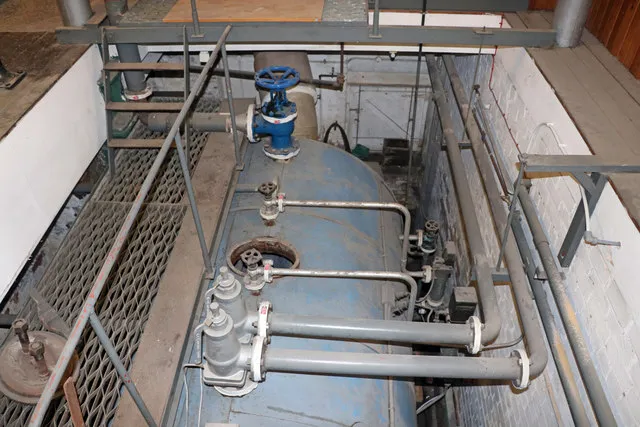
Photo: w_lemay, CC BY-SA 2.0, via Wikimedia Commons
Façade cleaning and external washdown are routine at many UK facilities, yet the water used often disappears into a gully with little measurement or thought. A building’s toilets and cooling towers attract water-efficiency attention because their consumption is visible. Washdown is different: it is episodic, spread across contractors and often treated as cleaning rather than a water stream. That makes it the other half of water efficiency — not because it is always large, but because it is frequently uncontrolled.
Recovering that water is feasible, but it is not a matter of placing a tank under a downpipe. A controlled reuse stream needs a catchment design, treatment matched to the end use, storage that does not become a water-safety problem, and a clear answer to the compliance questions that sit behind any discharge or reuse decision.
Start with a drain map, not a tank
Before specifying pumps or filters, map where washdown water goes. Walk the site with the cleaning contractor and the drainage drawings. Identify the façade cleaning method, the frequency of bin-store and loading-bay washing, the plant-room floor washdown routine, and any vehicle or yard cleaning. Note drain gullies, sumps, interceptors and the points where surface water and foul water separate.
The map should show volumes as well as routes. A short trial using a flow meter on a hose or a temporary collection tank can give a better estimate than a spreadsheet. It should also record what the water picks up: grit, organic matter, cleaning agents, traffic film, oils, metals from cladding or rainwater goods, and any biocidal product used on the façade. These contaminants determine whether recovery is sensible or whether the stream should go to foul drainage under a trade effluent consent.
Catchment options that suit the cleaning method
There is no single catchment solution. For façade cleaning, the most practical approach is often capture at ground level rather than a permanent network. Temporary bunding, sheeting, recovery mats and vacuum-booms can collect run-off before it reaches a gully. The collected water can be pumped to a mobile tank or a nearby sump. This works well for periodic cleaning, but it depends on the contractor’s method and on a site-specific risk assessment for working at height and around public areas.
For regular yard and loading-bay washdown, a dedicated collection sump at a low point may be more appropriate. The sump should be separated from foul drainage and fitted with a silt trap and, where oils or fuels are present, a coalescing separator. A first-flush diversion can send the dirtiest initial run-off to foul drainage, keeping the recyclable fraction cleaner. Gully isolation is useful during cleaning but must not compromise normal surface-water drainage or fire access.
Not every stream should be recycled. Water containing high concentrations of cleaning chemicals, disinfectants or oil may be better sent to foul drainage with the sewerage undertaker’s agreement. The aim is a controlled reuse stream, not a closed loop at any cost.
Pre-treatment and filtration choices
Recovered washdown water is not clean water. Gross solids and grit should be removed first, followed by silt settlement and oil separation where relevant. Filtration then depends on the end use. For yard washdown, bag or cartridge filtration may be enough to protect pumps and nozzles. For façade rinsing, where spotting and staining matter, finer filtration and possibly activated carbon may be needed to reduce organics and colour. If the water is to be stored for any length of time, disinfection — ultraviolet or a chlorine-based residual — may be appropriate, but it must be compatible with the cleaning chemicals and with the materials in the system.
Treatment should be selected against a specification. Turbidity, pH, conductivity, residual chlorine and microbial counts are useful parameters. For a non-potable washdown stream, the specification can be modest; for any use that creates aerosols or could come into contact with people, the risk assessment needs to be more cautious. Filtration is not a substitute for source control. If the catchment is contaminated with a cleaning product that is not compatible with the treatment train, the system will struggle.
Storage and monitoring
Storage should be sized to the cleaning pattern, not to the maximum possible rainfall. A tank that holds several days of demand will stagnate in quiet periods. A smaller tank with a mains top-up through an air gap is often more practical, provided the top-up is controlled and the tank is labeled as non-potable. Tanks should be covered, vented, insect-proof and accessible for cleaning.
Instrumentation matters. Level sensors prevent pumps running dry and alert the team to leaks. A flow meter shows how much water is actually being reused. Turbidity and pH monitoring can trigger diversion to drain if quality falls outside the agreed range. Sample points should be fitted at the tank outlet and after treatment. Alarms should go to the facilities helpdesk, not to an unread local panel. A simple log of cleaning, filter changes and sample results turns a pilot into a managed system.
Compliance questions to ask before specifying
The first question is where the water would otherwise go. Discharge to foul sewer may require a trade effluent consent from the sewerage undertaker. Discharge to surface water or groundwater may need an environmental permit or a registered exemption, depending on the volume and content. Reuse on site does not remove those questions if there is a surplus or a spill pathway.
The second is water fittings. Any mains top-up must comply with the Water Supply (Water Fittings) Regulations 1999 and be protected against backflow. Non-potable pipework should be clearly identified and separated from potable services. If the recovered water is used for anything beyond external washdown, the risk assessment and the fittings protection need to be revisited.
The third is water safety. Stored water, aerosols from pressure washing and warm tanks can create conditions that support microbial growth. A Legionella risk assessment should consider the system, even if it is non-potable. Cleaning chemicals bring COSHH duties. Silt and oil removed by pre-treatment are wastes and need duty-of-care records.
Finally, ask who owns the system. A reuse scheme that depends on a cleaning contractor’s equipment can fail when the contract changes. Responsibilities for sampling, filter replacement, tank cleaning and record-keeping should be written into the operating regime.
A successful scheme usually starts small: one catchment, one end use and a measured trial. If the volumes justify it, the treatment train can be expanded. If they do not, the exercise still produces a better drain map and a clearer understanding of where washdown water goes. That is useful water efficiency in its own right.