The Fading Signal: A Building-Wide Survey of Chlorine Residual
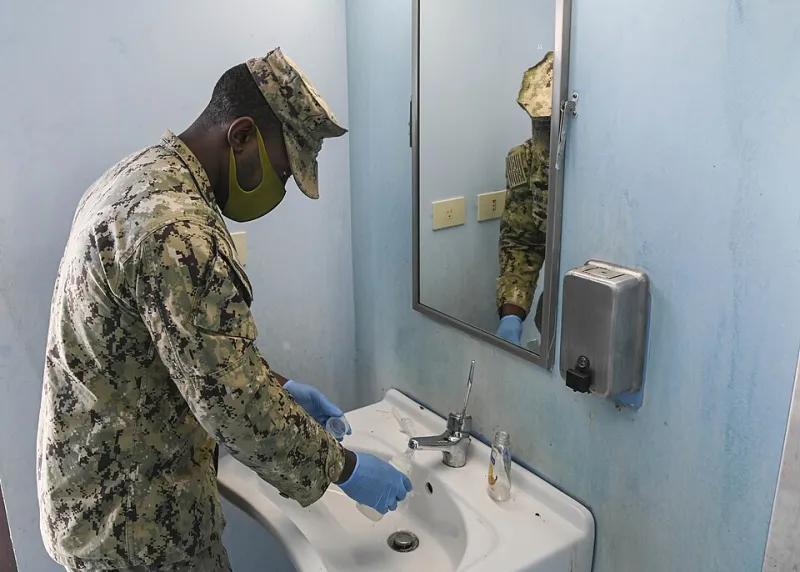
Photo: U.S. Navy photo by Petty Officer 2nd Class Josh Cote, Public domain, via Wikimedia Commons
Chlorine residual is a deceptive measurement. It can look reassuring at the point where water enters a building and equally reassuring at a sentinel tap, while the distribution system between those two points tells a different story. On a UK estate with storage tanks, long risers, low-use branches and mixed occupancy, residual is not a single number. It is a profile. The practical task is to find where the signal fades, why it fades there, and what action is proportionate.
Begin with the distribution, not the tap
A residual survey should start with a schematic, not a sampling bottle. Use the estate's water distribution drawing, or create one if it does not exist, and mark every asset that can influence water age: the incoming main and meter, storage tanks, booster sets, water softeners, filters, calorifiers, risers, isolation valves, dead legs and terminal outlets. Then define sample points that represent the route rather than merely convenient taps.
A workable register might include the incoming supply after the meter, each tank inlet and outlet, the discharge of any booster set, the top and bottom of each riser, a sentinel tap on every branch, the furthest outlet on a long run, and at least one low-use outlet that is not routinely flushed. Number the points and label them physically. Record pipe material, diameter, approximate run length, tank volume, occupancy pattern and any recent works. The map should be stable enough to compare results across seasons, but it should also be updated when the building changes.
Sampling that can be compared
Residual results are only useful if the method is consistent. Use a calibrated DPD photometer or colorimeter, follow the manufacturer's instructions, and record the sample time, water temperature, pH where relevant, and the point identifier. Two sampling modes are commonly used: a flushed sample after a defined purge, which gives a better indication of the supply arriving at that point, and a stagnation sample taken before flushing, which reflects local conditions in the pipe or outlet. Neither is inherently wrong, but they must not be mixed within a trend series without a note.
Regulatory sampling may prescribe its own method and frequency. The survey should sit alongside compliance sampling, not replace it. Keep the field records tidy: who took the sample, when, which mode, and what the reading was. A photograph of the labelled point is often more useful than a long description.
Reading the decay profile
Chlorine residual naturally declines as water travels. It reacts with pipe surfaces, biofilm, sediment and organic matter, and it decays faster in warm water and in systems with long residence times. The pattern matters more than any single result. A gradual fall from the incoming main through successive risers suggests estate-wide water age or demand patterns. A sharp step change across a storage tank points to turnover, stratification, sediment or tank condition. A localised drop at one branch suggests stagnation, a dead leg, an unrecorded filter or a local contamination issue.
Low-use branches deserve particular attention. A branch that serves a remote WC block, a standby kitchen or a seasonal laboratory may sit undisturbed for days. The residual there can fall to near zero while the rest of the building remains satisfactory. That does not automatically mean the whole estate is failing, but it does mean the branch needs a flushing regime, a use-change review or, in some cases, removal from service.
Temperature is a useful companion measurement. A warm loop with a falling residual may be telling you about circulation, insulation or stratification rather than about the incoming water. Likewise, intermittent low readings at the same outlet may reflect when the outlet was last used. The survey should capture use patterns, not just chemistry.
Correct the cause before correcting the number
The first response to a falling residual should be operational. Check tank turnover and cleaning records. Review flushing regimes for low-use branches. Balance loops so that water does not short-circuit through the easiest path while distant legs stagnate. Remove genuine dead legs where possible. Confirm that filters and softeners are not creating unrecorded residence time or removing disinfectant. These measures address the reason residual is being lost.
Booster dosing is a more serious intervention. It should follow a risk assessment and should not be used simply to lift a reading that has fallen because of poor turnover. On premises connected to the public main, the regulated supply boundary and the need for consent or notification should be confirmed with the water undertaker and local authority before any booster chlorination is installed. Where boosting is justified, the objective is to maintain a minimum residual through the distribution system, not to achieve a high number at the plant room. Over-dosing can create taste and odour problems, increase disinfection by-product formation and mask the underlying hydraulic problem.
Local filtration is a different tool. Point-of-use activated carbon can improve taste and remove chlorine at a specific outlet, but it also removes the residual protection at that point. It must be matched by a microbiological risk assessment, a filter replacement regime and clear labelling. It is not a substitute for estate-wide residual management, and it should not be installed merely to quieten a complaint without understanding the cause.
Taste and odour complaints are evidence, not instructions
A chlorinous complaint does not always mean residual is too low. It may mean residual is locally high, that the water has been sitting in a warm pipe, or that a filter or softener is contributing its own taste. Investigate the complaint at the outlet, then trace backwards. Compare flushed and stagnation samples. Ask when the outlet was last used. Check for recent works, changes in tank operation or new point-of-use devices. Responding to every complaint by increasing dose is likely to make the problem worse and can obscure a genuine water-quality issue.
Run the survey as a cycle
A residual survey is most useful when repeated. A first round establishes the map and the baseline. A second round after flushing, loop balancing or tank cleaning shows whether the intervention worked. Seasonal repeats capture warmer months, holiday shutdowns and changes in occupancy. Review the results against the sample-point map and record the actions taken. Over time, the estate builds a residual history that is far more informative than a folder of isolated certificates.
The residual mile is not a pass or fail at the final tap. It is a line of evidence from inlet to outlet. Map it, sample it consistently, interpret the pattern and correct the cause before adjusting the dose. That approach keeps water safety, taste and operational cost in the same conversation.